
1.How demerit points work
- Demerit points are not something you lose; they are added. Everyone starts at zero, and a conviction for certain traffic offences adds points to your record.
- Points remain on your record for two years, counted from the date of the offence.
- A driver with a full licence gets a warning letter at 6 to 8 points, a second warning letter at 9 to 14 points, and a 30-day suspension at 15 or more points.
- Holders of a G1, G2, M1, M2, M1-L or M2-L licence count as novice (new) drivers. For them, 2 to 5 points brings a warning letter, 6 to 8 points a second letter, and 9 or more points a 60-day suspension.
- When your licence is suspended you get a letter from the Ministry of Transportation telling you when the suspension takes effect and that you must surrender your licence. If you do not surrender it, you can lose your licence for up to two years.
- Coming off a suspension, you may have to retake the vision, written and road tests. Once reinstated, a full licence holder’s points are reduced to 7 and a novice licence holder’s points are reduced to 4.
- A suspended licence means no driving at all, in any circumstances. Driving while suspended for a Highway Traffic Act offence brings fines in the thousands of dollars, and the court may order up to six months in jail.
| Driver | Points | What happens |
|---|---|---|
| Full licence | 6 to 8 | Warning letter |
| Full licence | 9 to 14 | Second warning letter |
| Full licence | 15 or more | Licence suspended for 30 days |
| Novice (G1 / G2 / M1 / M2) | 2 to 5 | Warning letter |
| Novice (G1 / G2 / M1 / M2) | 6 to 8 | Second warning letter |
| Novice (G1 / G2 / M1 / M2) | 9 or more | Licence suspended for 60 days |
Official source: Ontario.ca – Understanding demerit points ↗ · MTO Driver’s Handbook – Other ways lose your licence ↗
2.What common offences are worth
- Seven demerit points are added for failing to remain at the scene of a collision, and for failing to stop when signalled or asked by a police officer.
- Six points go on your record for careless driving, for racing, for failing to stop for a school bus, for speeding by 50 km/h or more anywhere, and for speeding by 40 km/h or more where the limit is under 80 km/h.
- Five points apply to bus drivers only, for not stopping at a railway crossing that has no protection.
- Four points come with speeding by 30 to 49 km/h over the limit, with tailgating, and with not stopping at a pedestrian crossover.
- Three-point offences include speeding by 16 to 29 km/h, not obeying a stop sign or traffic light, not yielding the right-of-way, using or holding a hand-held wireless communications or entertainment device at the wheel, improper passing, and not slowing down and passing carefully when an emergency vehicle is stopped.
- Two-point offences include an improper right or left turn, a prohibited turn, opening a vehicle door improperly, driving unnecessarily slowly, reversing on a highway, not dipping your high beams, not obeying signs, not sharing the road, not signalling, and a driver not wearing a seat belt.
| Points | Offences |
|---|---|
| 7 | Leaving the scene of a collision; not stopping when a police officer signals or asks you to |
| 6 | Careless driving, racing, speeding by 40 km/h or more where the limit is under 80 km/h, speeding by 50 km/h or more, and not stopping for a school bus |
| 5 | Not stopping at an unprotected railway crossing (applies to bus drivers only) |
| 4 | Speeding by 30 to 49 km/h, following too closely, and not stopping at a pedestrian crossover |
| 3 | Speeding by 16 to 29 km/h; holding or using a hand-held wireless communications or entertainment device while driving; going through, around or under a railway crossing barrier; travelling the wrong way on a divided road; driving on a closed road; not yielding the right-of-way; not obeying a stop sign, traffic light or railway crossing signal; not following a police officer’s directions; not reporting a collision to the police; not slowing down and passing a stopped emergency vehicle carefully; improper passing; not keeping properly to a marked lane; crowding the driver’s seat; heading the wrong way down a one-way road; having a radar detector in the vehicle; improper use of an HOV lane |
| 2 | Improper right turn; improper left turn; opening a vehicle door improperly; a prohibited turn; towing someone on a toboggan, bicycle or skis; driving unnecessarily slowly; reversing on a highway; not dipping your headlamp beams; not obeying signs; not stopping at a pedestrian crossing; not sharing the road; not signalling; a driver not wearing a seat belt |
Official source: Ontario.ca – Understanding demerit points ↗
3.Escalating penalties for novice drivers
- For certain offences, novice drivers face "escalating" penalties, which grow harsher with each repeat of a similar offence, and these come on top of what every driver would get.
- They can be triggered by a conviction for breaking a graduated licensing rule, by a Highway Traffic Act conviction carrying four or more demerit points, or by a suspension ordered by a court for a Highway Traffic Act offence that would otherwise have brought four or more demerit points.
- A first offence costs you your licence for 30 days.
- A second offence means a 90-day suspension.
- A third offence cancels your novice licence. You have to re-apply and begin again, retaking every test and paying every fee; any time discount or credit you had built up is gone, and so are the fees you already paid.
- A novice driver convicted of a novice-condition violation or an offence worth four or more demerit points receives the Novice Driver Escalating Sanction suspension, and the demerit points are then recorded as zero and do not count towards the accumulated demerit point system.
Official source: Ontario.ca – Understanding demerit points ↗ · MTO Driver’s Handbook – Keeping your drivers licence ↗
4.Alcohol and drugs
- Driving counts as impaired whenever alcohol, cannabis, over-the-counter drugs, prescription medication, illegal substances or any mix of them has weakened your ability to drive, even slightly.
- Charges can follow at a blood alcohol concentration of 0.08 or more, and also in the warn range, which runs from 0.05 to 0.079.
- In the warn range you face a 7-day immediate licence suspension, an 8-hour education course and a $250 penalty the first time; 14 days, a 16-hour treatment program and $350 the second time; and 30 days, a 16-hour treatment program, a six-month ignition interlock condition and $450 the third time.
- With a BAC of 0.08 or more, or if you refuse or otherwise fail to comply with a demand for alcohol or drug testing, the penalties are immediate: your licence is suspended for 90 days, the vehicle is impounded for 7 days and you pay a $550 penalty.
- Ontario’s zero tolerance law means no alcohol at all in your system if you are 21 or under, or if you hold a G1, G2, M1 or M2 licence at any age. The same zero-tolerance rule covers cannabis.
- Breaking the zero-tolerance rule brings a 7-day immediate licence suspension and a $60 to $1,000 fine if convicted for a first occurrence, 14 days for a second and 30 days for a third. A conviction can add a further suspension of 30 or 90 days, or cancel the licence outright, with the outcome depending on your age and the class of licence you hold.
- If you are convicted criminally of impaired driving you can face additional fines and jail time, plus a licence suspension of at least 1 year, a mandatory education or treatment program, and an ignition interlock device for at least 1 year.
- Alcohol can blur or double your vision, make it hard to keep your attention on the road and what is around you, and slow your reflexes.
Official source: Ontario.ca – Impaired driving ↗
5.Stunt driving and other serious offences
- Stunt driving includes going 40 km/h or more over the limit where that limit is below 80 km/h, and going 50 km/h or more over the limit anywhere. Anyone caught at 150 km/h or more faces a stunt driving charge no matter where in the province it happens.
- Stunt driving or street racing brings penalties on the spot: your licence is suspended for 30 days and the vehicle is impounded at roadside for 14 days, even if it is not yours. On top of that come a fine of at least $2,000 and at most $10,000, six demerit points, and up to six months in jail.
- A conviction for stunt driving or street racing also means losing your licence for between one year and three years the first time, and for life if it happens again.
- A careless driving conviction can bring a fine of as much as $2,000, six demerit points, as long as six months in jail, and a licence suspension lasting up to two years.
- For a novice driver, a conviction for speeding 30 km/h or more over the limit, tailgating, careless driving, leaving the scene of a collision or stunt driving means a licence suspension of at least 30 days and possibly the cancellation of the licence.
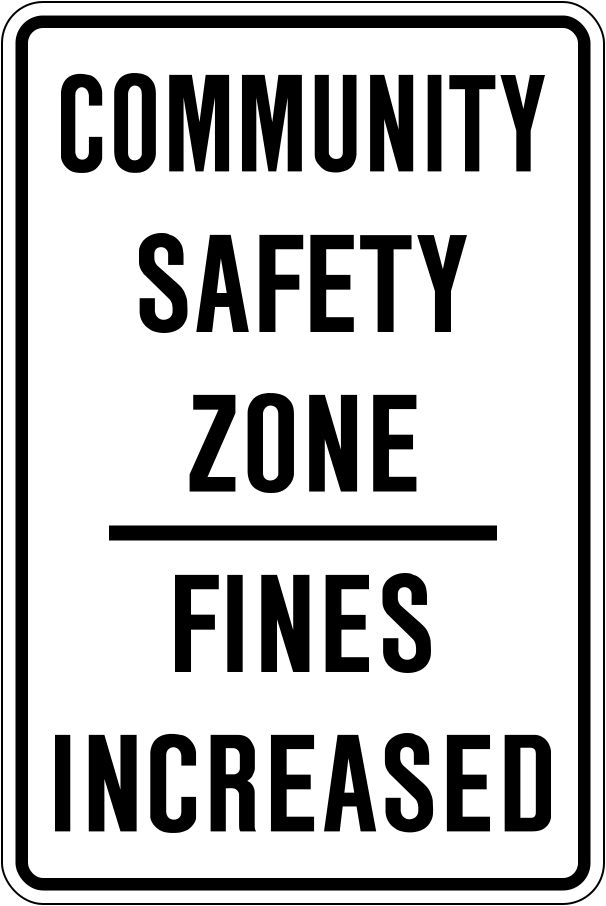
- Fines for speeding in a construction zone are doubled when workers are present, and traffic-related offences committed within a community safety zone are subject to increased fines.
Signs in this section
Official source: MTO Driver’s Handbook – Speeding and aggressive driving ↗ · MTO Driver’s Handbook – Dealing particular situations ↗ · MTO Driver’s Handbook – Signs ↗
6.Insurance, records and other long-term costs
- A conviction for aggressive, careless or stunt driving pushes insurance premiums up sharply, and some drivers find no insurer will cover them at all.
- Crash after drinking and driving and your insurer may refuse to cover your medical or rehabilitation bills, and may refuse to pay for the damage to either vehicle. Expect your premiums to climb sharply, and possibly heavy legal bills on top.
- A first Criminal Code conviction costs you your licence for one year; later convictions carry far longer suspensions, up to a lifetime ban, and each one stays on your driving record for at least 10 years.
- How many impaired-driving convictions you already have decides the outcome, which can be a fine as high as $50,000, a jail sentence or the permanent loss of your licence.
- Impaired driving that injures someone can be punished with as much as 14 years in prison, and impaired driving that kills someone can bring a life sentence.
- For anyone whose job involves driving, a suspension can mean losing the job itself.
Official source: MTO Driver’s Handbook – Speeding and aggressive driving ↗ · MTO Driver’s Handbook – Other ways lose your licence ↗