
1.Where you may not park
- The travelled part of a road is never a parking spot. If you have to stop, get fully off the road and onto the shoulder.
- Do not park on a curve or a hill, or at any spot where the view in each direction is less than 125 metres.
- Parking must not box in a vehicle that is already parked, and must not obstruct a sidewalk, crosswalk, pedestrian crossing or road entrance.
- Keep at least three metres from a fire hydrant, stay off a bridge and the 100 metres on either side of it, and keep six metres clear of the public entrance to a hotel, theatre or public hall while it is open to the public.
- Stay at least nine metres back from an intersection when you park, and 15 metres back where the intersection has traffic lights.
- At a level railway crossing, parking is prohibited within 15 metres of the nearest rail.
- Choose a spot that will not obstruct traffic or snow-clearing equipment.
- A space reserved for people with disabilities is off limits unless an Accessible Parking Permit is displayed in your windshield, and that permit has to belong to you or to one of your passengers.
| Where | Rule |
|---|---|
| Fire hydrant | 3 m |
| Bridge | 100 m (and never on the bridge itself) |
| Public entrance to a hotel, theatre or public hall (when open to the public) | 6 m |
| Intersection | 9 m |
| Intersection controlled by traffic lights | 15 m |
| Closest rail at a railway level crossing | 15 m |
| Curve or hill, or anywhere your view is blocked | Never park; you need a clear view for at least 125 m in both directions |
| A sidewalk, a crosswalk, a pedestrian crossing or a road entrance | Never block it |
| Space designated for people with disabilities | Only with an Accessible Parking Permit displayed in the windshield |
Official source: MTO Driver’s Handbook – Parking along roadways ↗
2.No stopping, no standing and no parking
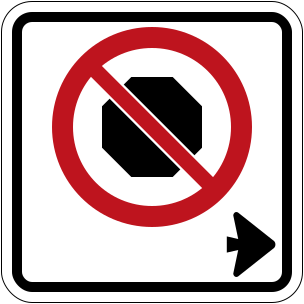
- A "no stopping" sign means you may not stop your vehicle in that area, even for a moment.
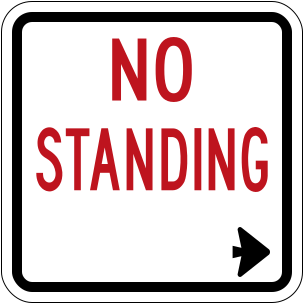
- A "no standing" sign means you may not stop your vehicle in that area except while loading or unloading passengers.
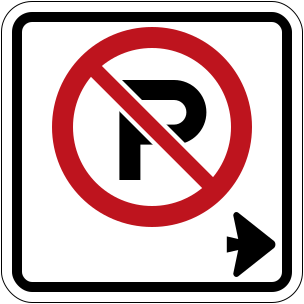
- Where a "no parking" sign is posted, the only reason you may stop is to let passengers or goods on or off.
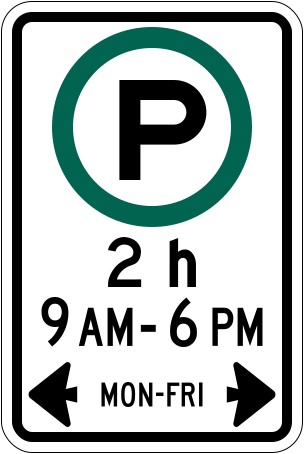
- A "parking permitted" sign carries a green circle, which means you may do the activity shown: parking is allowed between the signs at the times they list.
- These signs are used in pairs or groups, and the restriction applies to the area between the signs.
- Parking rules change from road to road and place to place, so always watch for and obey signs that limit stopping, standing or parking. Bear in mind that a by-law can apply even where no sign spells it out.
Signs in this section
Official source: MTO Driver’s Handbook – Signs ↗ · MTO Driver’s Handbook – Parking along roadways ↗
3.Parking on a hill
- Facing downhill, point the front wheels toward the curb or the right shoulder, so that if the brakes let go the vehicle rolls away from traffic rather than into it.
- When facing uphill with a curb, turn the steering wheel to the left so the wheels point towards the road. The tires will catch the curb if the vehicle rolls backward.
- Facing uphill where there is no curb, steer the wheels hard to the right; a vehicle that rolls back then heads off the road instead of into traffic.
- On any hill, apply the parking brake and put an automatic in park; with a manual transmission, leave it in first or reverse.
- Then switch off the engine, take the key with you, look for traffic before you open the door, and lock up.
Official source: MTO Driver’s Handbook – Parking along roadways ↗
4.Parallel parking and roadside stops
- Parallel parking is parking with the wheels alongside and parallel to the curb or the edge of the road, on the right side, facing the same way as the traffic.
- Where parking is allowed, the default is parallel to the curb; angle parking applies only where signs call for it. On a one-way road, both sides are available for parallel parking unless signs say otherwise.
- To parallel park on the right-hand side, find a space about one and one-half times longer than your vehicle, then pull up beside the car parked in front of it, keeping roughly a metre of space between you, and stop with your rear bumper level with theirs.
- Back slowly and carefully into the space with the steering wheel turned all the way toward the curb. Once the outside rear corner of the car ahead comes into view, straighten up while still reversing, then turn the wheel all the way toward the road so the vehicle ends up parallel to the curb.
- Once the vehicle is in position, apply the parking brake and put an automatic in park, or a manual in first or reverse. Switch off the engine, take the key, look for traffic before you open the door, and lock up.
- For a roadside stop, ease toward the side of the road as you slow down steadily, and come to rest parallel with the curb or road edge, within about 30 centimetres of it. Pick a spot that does not block an entrance or get in the way of other traffic.
- Leaving a parking spot starts with a signal and a check for traffic. Right before you pull out, check the mirrors and the blind spot once more for vehicles and cyclists.
Official source: MTO Driver’s Handbook – Parking along roadways ↗
5.Opening doors safely
- Opening the door of a parked vehicle comes after checking, never before: make sure no person, vehicle or passing traffic will be endangered or obstructed.
- Parked at the roadside, look back over your shoulder and in the mirrors for a cyclist coming up before any door opens.
- A good practice is the Dutch reach method: open the driver’s door with your right hand, which forces a shoulder check at the same time.
- Cyclists often ride close to the line of parked cars, so be especially careful not to swing a door into their path.
- If a door has to open on the traffic side, keep it open just long enough for passengers to get in or out.
- Improper opening of a vehicle door adds 2 demerit points to your record if you are convicted.
Official source: MTO Driver’s Handbook – Parking along roadways ↗ · MTO Driver’s Handbook – Sharing road other road users ↗ · Ontario.ca – Understanding demerit points ↗
6.Leaving your vehicle
- When you leave the vehicle, switch off the ignition and the lights, take the key with you and lock the doors; it makes the car a harder target for thieves.
- Never leave a child or an animal behind in the vehicle.
- Apply the parking brake and put an automatic in park, or a manual in first or reverse.
- Check traffic before opening your door, and lock your vehicle when you leave it.
- Signal and check for traffic before leaving a parking spot, and pull out only once it is safe.
Official source: MTO Driver’s Handbook – Parking along roadways ↗