
1.Red, amber and green lights
- A red light means stop. Come to a complete stop at the painted stop line if there is one; failing that, before the crosswalk, marked or not; failing that, at the edge of the sidewalk; and failing that, at the edge of the intersection.
- Move on only when the light has turned green and the intersection ahead is clear.
- A right turn on red is permitted unless a sign forbids it, and only after a complete stop and a clear way. Disobeying a traffic light adds three demerit points.
- A left turn on a red light is allowed when both the road you are leaving and the road you are entering are one-way, provided you first stop completely, check that the way is clear, and yield to pedestrians and traffic.
- Yellow (amber) is the warning that red is next. Stop if you can do it safely; if you cannot, continue through with caution.
- Green lets you go straight, left or right, once you have given way to vehicles and pedestrians already in the intersection. Pedestrians crossing have priority over any turn you make.
- A left turn on a plain green light is allowed, but only once traffic and pedestrians are out of the way. If you are already in the intersection when the light goes red, finish the turn as soon as it is safe.
Signs in this section
Official source: MTO Driver’s Handbook – Traffic lights ↗ · MTO Driver’s Handbook – Changing directions ↗ · MTO Driver’s Handbook – Keeping your drivers licence ↗
2.Advance green and green arrows
- A flashing green light, or a green light with a left-pointing green arrow, lets you turn left, go straight or turn right from the correct lane. It is known as an advanced green: the oncoming traffic is still being held on red.
- A flashing green light or a left-turn green arrow is not a signal for pedestrians to cross; they wait unless a pedestrian signal says otherwise.
- A green left-turn arrow shown together with a red light allows a left turn from the left-turn lane. Expect drivers coming the other way to be turning left at the same time, since they may have the same arrow.
- The green left-turn arrow may be followed by a yellow arrow, which warns that the green light is coming for traffic in one or both directions. Do not begin a left turn on it; stop if you safely can, and if you are already turning, finish with caution.
- At some intersections, left-turning traffic has its own set of lights, separate from the lights for going straight or turning right. There, once the green appears for the straight-ahead and right-turning traffic, you may no longer start a left turn; should the light go yellow while you are already in the intersection, finish the turn carefully.
Signs in this section
Official source: MTO Driver’s Handbook – Traffic lights ↗ · MTO Driver’s Handbook – Pedestrian signals ↗
3.Flashing lights, beacons, dark signals and people directing traffic
- A flashing yellow light calls for caution: slow down and look carefully as you approach and pass through the intersection.
- Treat a flashing red light as a stop sign: a complete stop, then through the intersection only when it is safe.
- A beacon is a single flashing light, hung above an intersection or mounted over a sign or on an obstacle in the road. Red means a complete stop; yellow means proceed with caution.
- When a power failure puts the lights out, the intersection becomes an all-way stop. Give way to vehicles already in it and to vehicles entering from your right, and go through with caution.
- At an all-way stop, whoever came to a complete stop first goes first. If two vehicles stop together, the one on the right has priority and the one on the left waits.
- A police officer directing traffic overrides the lights and the signs: follow the officer. Ignoring a police officer’s directions adds three demerit points.
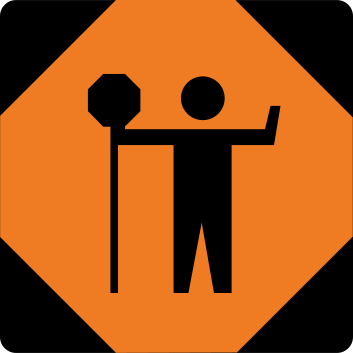
- An orange temporary-condition sign showing a person with a flag means a traffic control person is ahead: drive slowly and watch for instructions.
Signs in this section
Official source: MTO Driver’s Handbook – Traffic lights ↗ · MTO Driver’s Handbook – Driving through intersections ↗ · MTO Driver’s Handbook – Driving along ↗ · MTO Driver’s Handbook – Keeping your drivers licence ↗ · MTO Driver’s Handbook – Signs ↗
4.Pedestrian signals
- At signalised intersections, pedestrians get their own signals. A white walking figure means cross; an orange hand, flashing or steady, means do not start crossing.
- The walk signal lets a pedestrian cross in the direction it faces, and a pedestrian who is crossing has priority over every vehicle until they reach the other side.
- Once the hand shows, flashing or steady, a pedestrian should not step off the curb. Anyone already on the crossing when it appears should get to a safe spot as quickly as they can, and keeps the right-of-way over vehicles until they do.
- Where the lights have no separate pedestrian signal, a pedestrian may cross on a green light. A flashing green or a green left-turn arrow is not a signal for pedestrians to cross.
- If there is a push-button, the walk signal only comes on when a pedestrian presses it. A pedestrian signal allows more crossing time than the ordinary traffic light does.
- An intersection pedestrian signal puts traffic lights on the main road only, together with a crosswalk or several, walk and don’t walk signals and push buttons for pedestrians. The quieter crossroad is controlled by stop signs instead.
Signs in this section


Official source: MTO Driver’s Handbook – Pedestrian signals ↗
5.Pavement markings: yellow and white lines
- Lines painted on the road work alongside signs and lights to show which way traffic flows and where you may and may not drive. The colour carries the meaning: yellow lines divide traffic going opposite ways, white lines divide traffic going the same way.
- A solid line on the left of your lane says passing is unsafe there; a broken line on the left says you may pass when the way is clear.
- Continuity lines are broken lines that are thicker and more closely spaced than the usual kind. On your left, they generally warn that your lane is about to end or exit, so you must change lanes to keep going the same way; on your right, they tell you your own lane carries on unchanged.
- A stop line is one white line painted across your lane at an intersection, marking where to stop. Without a stop line, you stop at the crosswalk, whether or not it is painted; without a crosswalk, at the edge of the sidewalk; and without a sidewalk, at the edge of the intersection.
- Two parallel white lines across the road mark a crosswalk, although at intersections a crosswalk may exist without being painted. Never park so that you block a sidewalk, a crosswalk, a pedestrian crossing or a road entrance.
- Two solid lines painted side by side on the pavement steer traffic clear of fixed obstacles such as bridge piers and concrete islands, and the obstacles themselves carry yellow-and-black warning markings.
Official source: MTO Driver’s Handbook – Pavement markings ↗ · MTO Driver’s Handbook – Parking along roadways ↗
6.Arrows and special lanes
- A white arrow painted in a lane limits that lane to the direction it points. Overhead signs, or markings on the pavement before an intersection, set the same kind of rule.
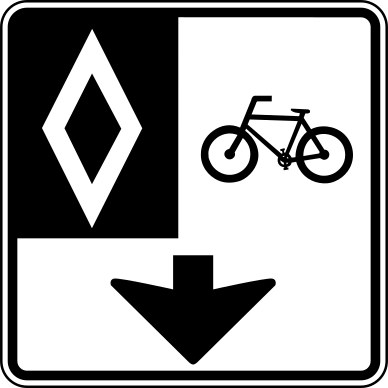
- An HOV (high occupancy vehicle) lane is reserved for public vehicles like buses and for passenger vehicles with at least the posted number of people on board. On provincial highways a striped buffer zone separates the HOV lane from the ordinary lanes; crossing those striped markings is both unsafe and against the law.
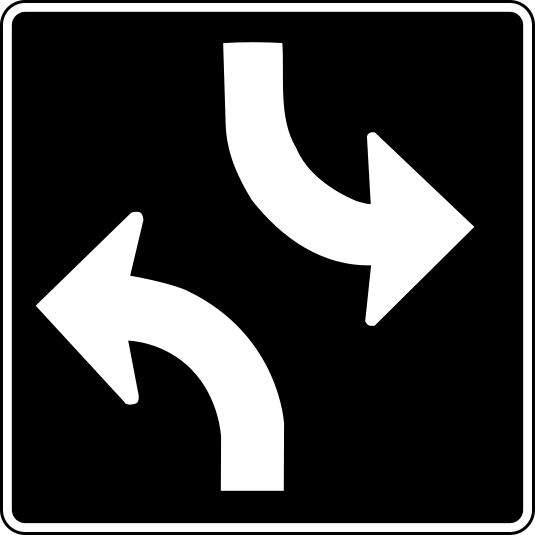
- Some roads set aside the centre lane as a two-way left-turn lane, where drivers from either direction can wait to turn left without blocking the traffic behind them. It is a turning lane only; passing in it is not allowed.
- Bike lanes are reserved for cyclists and are typically marked by a solid white line. A right turn at a corner or into a driveway sometimes means crossing or entering one; check that it is safe, move into the bike lane, and then make the turn.
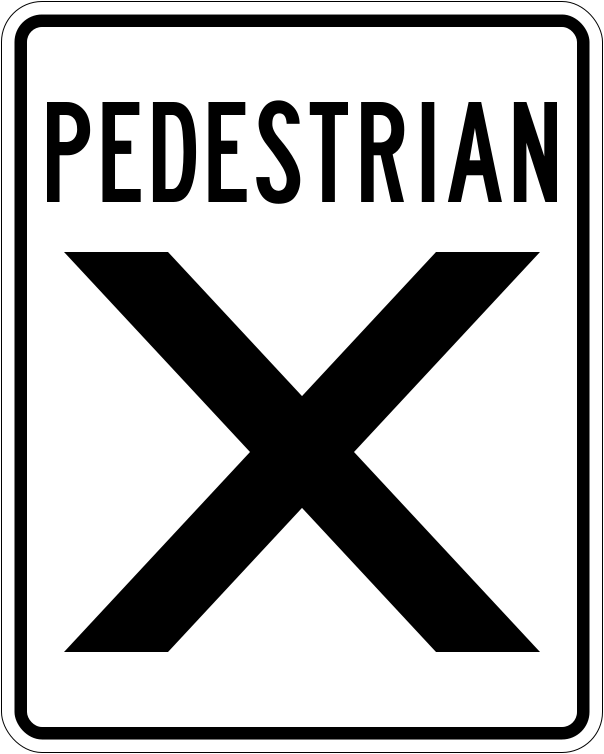
- You can recognize a pedestrian crossover by its signs, its overhead yellow lights and its road markings: two double white lines running parallel across the road, with an X painted in each approaching lane. Drivers and cyclists stop before the line and wait until the pedestrians are all the way across and off the roadway.
- No passing is allowed within 30 metres of a pedestrian crossover, whatever the vehicle ahead is doing.
Signs in this section
Official source: MTO Driver’s Handbook – Pavement markings ↗ · MTO Driver’s Handbook – Signs ↗ · MTO Driver’s Handbook – Freeway driving ↗ · MTO Driver’s Handbook – Changing directions ↗ · MTO Driver’s Handbook – Sharing road other road users ↗ · MTO Driver’s Handbook – Stopping ↗